Remote attestation lets a workload owner cryptographically verify that an expected software stack is running inside a genuine Trusted Execution Environment (TEE) before releasing secrets or sensitive data. It complements the runtime isolation dimension of confidential computing.
Runtime isolation provided by a TEE alone does not solve a fundamental problem: how can you verify that the TEE is genuine and started in a trusted state? Since a TEE is typically created and initialised by an untrusted host (for example, a hypervisor configuring the guest’s initial state), its security depends on verifying that the TEE was instantiated with the expected software and configuration before trusting it.
This is where remote attestation comes in. Remote attestation allows the TEE to produce cryptographic evidence of its identity and initial state. A remote verifier validates this evidence against expected measurements before establishing trust or releasing sensitive resources such as encryption keys, secrets, or credentials.
Remote attestation is what allows a remote party to confirm they are communicating with a genuine, unmodified TEE running the expected software.
Disambiguating “Attestation”
The term “attestation” is overloaded and worth clarifying before going further:
| Type | Characteristics |
|---|---|
| Host attestation (TPM-based) | Continuous, non-blocking; periodic checks; corrective actions on failure |
| Confidential attestation | Blocks secret delivery; scoped to the TEE’s initial state |
| SPIFFE/SPIRE workload attestation | One component attesting to properties of another |
The parties capable of validating a host environment versus a guest TEE environment are usually distinct, making these separate processes. This chapter focuses on confidential attestation.
Why Attestation Matters
Consider this scenario: you want to send sensitive data to a TEE running in a cloud provider’s infrastructure. Before you send your secrets:
How do you know the TEE is real (not a software simulation)?
How do you know it’s running the code you expect (not malware)?
How do you know the firmware hasn’t been tampered with?
Remote attestation answers all three questions cryptographically.
The IETF RATS Framework
The industry has standardized remote attestation procedures through the IETF RATS (Remote ATtestation procedureS) framework (RFC 9334).
The Attester (TEE) produces Evidence (measurements/claims), which the Verifier checks against Reference Values from a Reference Value Provider. The Verifier returns an Attestation Result to the Relying Party, which then decides whether to release a resource (e.g., a decryption key).
Key Roles and Artifacts
| Role / Artifact | Description | Example |
|---|---|---|
| Attester (role) | The entity being attested — generates evidence about itself | The TEE (CVM) |
| Evidence (artifact) | Claims produced by the Attester, containing measurements | Attestation report with PCR/RTMR values |
| Verifier (role) | Validates evidence against reference values | Attestation Service (AS) |
| Reference Value Provider (role) | Supplies the “golden” reference measurements | Firmware vendor, OS publisher |
| Relying Party (role) | Uses the attestation result to make decisions | Application owner, Resource gatekeeper |
Trustee (Chapter 11) implements the Reference Value Provider role as a component called the Reference Value Provider Service (RVPS). That name is Trustee-specific, not an IETF term.
Attestation Models
Background Check Model
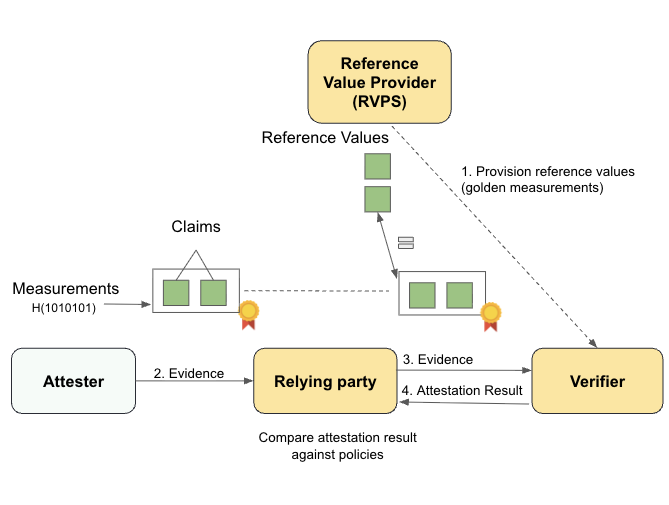
Here is the flow of a background check model:
RVPS provisions reference values (golden measurements) to the Verifier
Attester (TEE) sends Evidence to the Relying Party (attestation report: hardware measurements, firmware hash, etc.)
Relying Party forwards Evidence to the Verifier
Verifier compares Evidence against Reference Values
Verifier returns Attestation Result to the Relying Party
Relying Party decides whether to release the resource (key, secret, certificate)
Passport Check Model
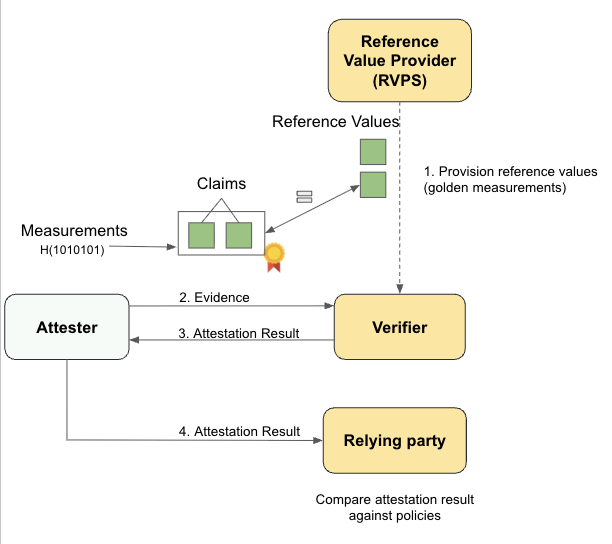
Here is the flow of a passport check model:
RVPS provisions reference values (golden measurements) to the Verifier
Attester (TEE) sends Evidence to the Verifier (attestation report: hardware measurements, firmware hash, etc.)
Verifier compares Evidence against Reference Values
Verifier returns Attestation Result to the Attester
Attester (TEE) presents Attestation Result to the Relying Party
Relying Party decides whether to release the resource (key, secret, certificate)
When to Use Each Model
| Background Check | Passport | |
|---|---|---|
| Verification trigger | Each Relying Party verifies independently | Attester verifies once; presents token to many |
| Freshness | Evidence is fresh per request | Token has a bounded validity window (TTL) |
| Relying Party requirement | Must have access to a Verifier | Only needs to validate the token signature |
| Best for | Single Relying Party, or when fresh evidence is required every time | Multiple Relying Parties that trust the same Verifier |
Verification Services
| Service | Provider | Supports |
|---|---|---|
| Intel Trust Authority (ITA) | Intel | TDX, SGX |
| Azure Attestation Service (MAA) | Microsoft | SNP, TDX, SGX |
| Trustee/AS | CNCF CoCo | SNP, TDX, SGX, IBM SE |
Attestation Operations in Practice
The mechanics above are the easy part. The recurring operational work in production attestation is managing reference values and policy over time.
Where reference values come from
A verifier needs “golden” measurements to compare Evidence against. In practice they come from three sources:
Vendor-published values: firmware vendors and OS publishers can publish expected measurements for their releases.
Computed from the image: tools compute the expected launch measurement directly from the artifacts you deploy. For example, sev-snp-measure derives the SNP launch measurement from a given OVMF binary, kernel, initrd, and command line. This is the most common approach for custom guest images.
Reproducible builds: if the guest image builds reproducibly, anyone can independently rebuild it and confirm the measurement, removing the need to trust the image publisher’s claim.
Measurement churn
Every update to a measured component (firmware, kernel, initramfs, kernel command line, agent policy) changes the measurements. That means:
Patching is an attestation event. A routine kernel security update will cause attestation failures unless the new reference values are provisioned to the verifier before the updated guests boot.
Rollouts need overlapping trust windows. During a fleet upgrade, the verifier must accept both the old and new measurements; the old values are retired once the rollout completes.
Automate the pipeline. Mature deployments generate reference values in CI as part of the image build and push them to the verifier (e.g., Trustee’s RVPS) in the same pipeline that publishes the image.
TCB versioning and recovery
Hardware vendors patch their own platform security (microcode, SNP firmware, the TDX module). The platform’s TCB version is reported inside the Evidence, and the signing key itself is bound to it (AMD’s VCEK is derived per TCB version). Verifier policy should enforce a minimum TCB version. This is how the ecosystem recovers from hardware vulnerabilities: the vendor ships fixed firmware, and verifiers raise the required TCB floor, causing unpatched hosts to fail attestation. A host that lags on firmware updates will (correctly) stop receiving secrets.
Policy, not just matching
Real verifiers don’t hard-compare every field. They evaluate Evidence against a policy (Trustee’s Attestation Service uses OPA Rego policies) that decides which claims matter: exact launch measurement pinning, minimum TCB version, allowed hardware models, debug-mode disallowed, and so on. Looser policies ease operations; tighter policies narrow the attack surface. Chapter 11 shows where these policies live in Trustee.
Security Considerations
Freshness: Always use nonces in attestation to prevent replay attacks.
Revocation: If a CPU is found vulnerable, AMD/Intel can revoke VCEK/PCK certificates. Verifiers should check revocation lists.
Third-Party Trust: When using cloud-provided attestation services, you trust the cloud provider’s attestation infrastructure. Self-hosted Trustee eliminates this dependency. Trustee is covered in detail in Chapter 11, along with its integration into the CoCo attestation flow.