Confidential Computing in cloud-native environments is organized into three deployment tiers, each building on the previous one.
The three pillars:
Confidential Virtual Machine — run a VM inside a TEE (the foundation)
Confidential Container — run a Kubernetes Pod inside a CVM
Confidential Cluster — run Kubernetes nodes themselves inside CVMs
Pillar 1: Confidential Virtual Machine (CVM)
A Confidential Virtual Machine is a VM that runs inside a TEE. It is the foundational building block.
What it provides:
VM memory is hardware-encrypted — the hypervisor cannot read it
Measured boot proves what software started inside the VM
Remote attestation allows external parties to verify the CVM’s state
TCB is reduced — you no longer need to trust the hypervisor or host OS
Pillar 2: Confidential Container (Pod)
A Confidential Container runs a Kubernetes Pod inside a CVM (which itself runs inside a TEE).
Key properties:
Each Pod gets its own CVM — strong isolation between Pods
The Kubernetes control plane (kubelet, containerd/crio) is outside the TEE — it is untrusted
Container images are downloaded inside the CVM, not on the worker node.
Secrets are delivered via remote attestation, not via K8s Secrets in etcd
Policy enforcement controls what the K8s control plane can instruct the CVM to do
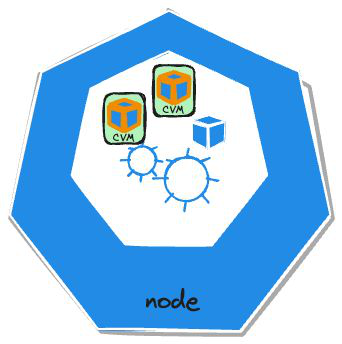
Implementation: The CNCF Confidential Containers (CoCo) project is the primary open-source implementation.
Pillar 3: Confidential Cluster
A Confidential Cluster runs Kubernetes nodes themselves inside CVMs (which run inside TEEs).
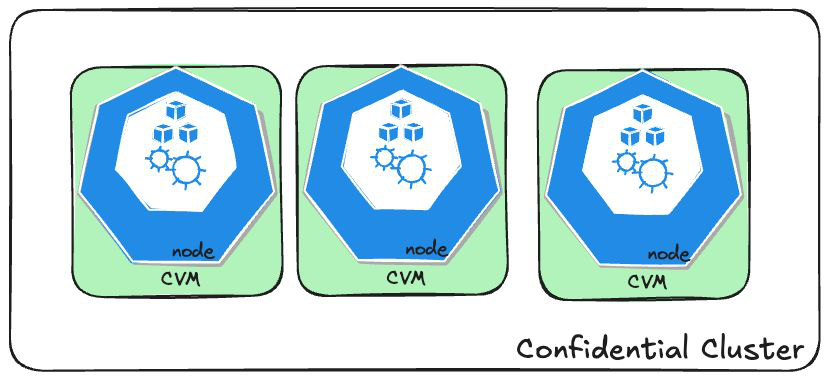
Comparing the Pillars
| Confidential VM | Confidential Containers | Confidential Cluster | |
|---|---|---|---|
| What’s in the TEE | The entire VM | The entire VM including the pod | Entire K8s nodes |
| K8s control plane | N/A | Untrusted (on regular infra) | Trusted (inside CVMs) |
| Trust boundary | VM level | VM level | Cluster level |
| Admin Trust | Infra admin is untrusted | Infra and cluster admin are untrusted | Infra admin is untrusted |
| Multi-tenancy | N/A | Since cluster admin is untrusted, each pod can belong to different tenant | Since cluster admin is trusted, it can’t be used for multi-tenancy |
| Operation Type | Standalone — no K8s required | Day 2 Operation — can be deployed on existing K8s cluster | Day 1 Operation — requires new K8s cluster |
| Use case | Protect standalone workloads | Workload isolation within K8s | Full cluster isolation |
Choosing the Right Pillar
| Requirement | Recommended Pillar |
|---|---|
| Protect standalone code | Pillar 1: CVM |
| Protect K8s pods from each other and cluster/infra admin | Pillar 2: Confidential Containers |
| Protect entire K8s cluster from infra admin | Pillar 3: Confidential Cluster |