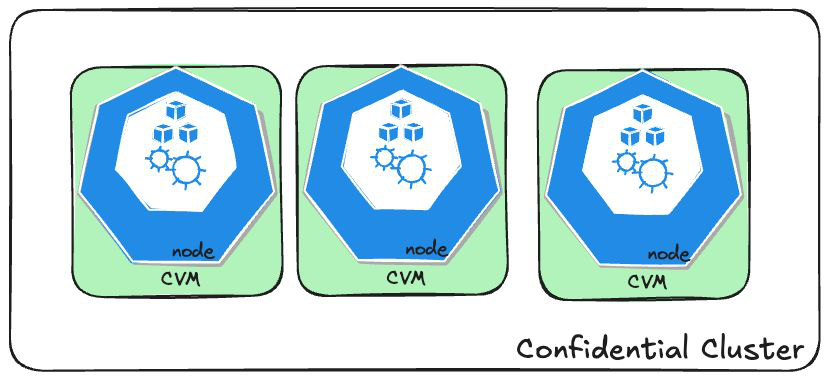
A confidential Kubernetes cluster uses Confidential Virtual Machines (CVMs) as Kubernetes nodes — both worker nodes that run workloads and, in a full deployment, control plane nodes that host the API server, etcd, and scheduler. Running every node inside a CVM prevents the cloud provider and infrastructure administrator from inspecting node memory, including workloads, secrets, and cluster state.
Threat Model
The confidential cluster threat model differs from both standard Kubernetes and Confidential Containers (Pillar 2).
What is untrusted:
| Component | Untrusted? | Why |
|---|---|---|
| Cloud provider / IaaS | ✔ Yes | Controls the hardware and hypervisor |
| Infrastructure admin | ✔ Yes | Can access the underlying host |
| Hypervisor | ✔ Yes | Excluded from the TCB by the TEE |
| Other VMs on the host | ✔ Yes | Memory isolation enforced by hardware |
What is trusted:
| Component | Trusted? | Why |
|---|---|---|
| Kubernetes cluster admin | ✔ Yes | Runs control plane components inside CVMs |
| Worker node software | ✔ Yes (once attested) | Node is a CVM with measured boot |
| Kubelet and container runtime | ✔ Yes | Running inside the CVM |
The key property: the cluster admin is trusted, but the infrastructure admin is untrusted. Note that for Confidential Containers both the cluster admin and infrastructure admin are untrusted.
How It Works
When a confidential cluster node boots, it goes through the same measured boot process as any CVM. The critical addition is that the cluster admission gate requires successful remote attestation before a node can join.
Only a node running the expected OS image inside a genuine TEE passes attestation and receives the credentials needed to join. A compromised or unverified node is denied admission.
Key Capabilities
Node Remote Attestation
Every node that attempts to join the cluster presents a hardware-signed attestation report. The control plane (or a delegated attestation service) verifies:
The node is running inside a genuine hardware TEE
The expected node OS image was booted
The hardware firmware is at a trusted patch level
This gates cluster membership based on the result of attestation.
Encrypted Disk Storage
Worker node disks must be encrypted to prevent the hypervisor from reading the persistent data. Boot disk encryption is tied to attestation: the decryption key is only released after the node proves it is running the correct software inside a TEE.
Encrypted Cluster Networking
In a standard cluster, inter-node traffic is plaintext on the cluster network — visible to anyone with host access. A confidential cluster implementation must use encrypted networking between nodes (e.g., using WireGuard), so the infrastructure admin cannot observe intra-cluster traffic.
Spectrum of Implementations
Not all confidential cluster deployments provide the same guarantees. There is a spectrum from partial (worker nodes only) to full (entire cluster).
Partial: Worker Nodes Only
Only the worker nodes run inside CVMs. The Kubernetes control plane (API server, etcd, scheduler) runs on regular infrastructure managed by the cloud provider.
Security properties:
Workload memory is encrypted and isolated from the host
Control plane state (etcd, secrets) is not in a TEE
Kubernetes secrets in etcd are accessible to the cloud provider unless separately encrypted
Node attestation may or may not be enforced at admission
Examples: GKE Confidential Nodes, AKS Confidential VM node pools
Full: Entire Cluster
All nodes, including control plane nodes run inside CVMs.
Additional security properties over partial:
etcd (cluster state) is inside a TEE
Cluster keys are managed within the TEE
A single verifiable attestation covers the whole cluster
Encrypted networking between all nodes
Examples: Constellation (Edgeless Systems) - this is no longer maintained, OpenShift Confidential Cluster (Red Hat)